Sourced technical reference
CNMG 432 Insert / CNMG120408
ANSI and ISO designation reference with source-backed dimensions.
Direct ANSI ↔ ISO Match
80° Rhombic · 0° Negative · 4 EdgesCNMG 432 = CNMG120408 — Reference Specifications
- IC
- 12.7 mm
- Thickness
- 4.763 mm
- Nose Radius
- 0.8 mm
- Hole Diameter
- approximately 5.16 mm
ISO 1832 / ANSI B212.4 Orthographic Profile
| Dimension | Metric (mm) | Inch (in) |
|---|---|---|
| Inscribed Circle (IC) | 12.7 mm | 0.500 in (1/2") |
| Insert Thickness (S) | 4.763 mm | 0.1875 in (3/16") |
| Corner Nose Radius (rε) | 0.8 mm | 0.0315 in (1/32") |
| Clamping Hole (d1) | ≈ 5.16 mm | ≈ 0.203 in |
| Relief Angle / Edges | 0° Negative · 4 edges | 0° Negative · 4 edges |
Geometry guide
Technical Drawing
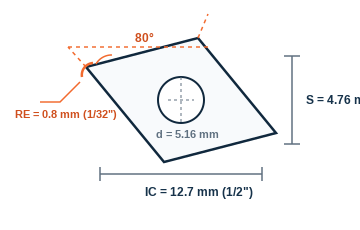
Geometry schematic only. Confirm the cited source record for product-specific dimensions.
Code conversion
ANSI to ISO Mapping
The documented mapping is ANSI CNMG 432 to ISO CNMG120408.
| ANSI | ISO | Status |
|---|---|---|
| CNMG 432 | CNMG120408 | Verified |
Designation structure
What CNMG 432 Means
CNMG identifies rhombic 80° geometry, no relief angle, tolerance class M, and a cylindrical clamping hole with chipbreaker on both faces. The sourced 432 / 120408 record supplies the specific dimensions shown above. Looking for factory-direct supply? Request pricing below.
Insert fundamentals
What Is a CNMG Insert
A CNMG insert is an ISO/ANSI standard negative turning insert engineered for heavy roughing and general turning. Its 4-letter designation specifies four geometric properties:
- C (Shape): 80° rhombic diamond geometry, balancing edge strength with turning clearance.
- N (Clearance): 0° normal relief angle (negative rake), making the insert double-sided with 4 usable cutting edges.
- M (Tolerance): Precision class M controlling IC, thickness, and nose height for CNC repeatability.
- G (Type): Cylindrical center clamping hole with double-sided chipbreakers.
Machinists choose CNMG inserts as their primary turning tool for steel, stainless, and cast iron.
Corner geometry
What Is the Corner Radius of a CNMG 432
The corner radius of a CNMG 432 is 0.8 mm (1/32 in, 0.031 in). The ANSI size numbers decode as:
- 4: 4/8 in (1/2 in or 12.7 mm) Inscribed Circle.
- 3: 3/16 in (4.763 mm) insert thickness.
- 2: 2/64 in (1/32 in or 0.8 mm) nose radius ("08" in ISO).
The 0.8 mm radius creates a variable-thickness chip transition zone along the cutting arc. Because the chip thins toward the finished part diameter, this 0.8 mm geometry provides a natural burnishing action that balances edge toughness with cutting pressure.
Select the proper insert nose radius to control part deflection, eliminate harmonic vibration, and hit specified Ra roughness targets across diverse CNC feeds.
Tool selection comparison
CNMG vs TNMG
Evaluating CNMG vs TNMG depends on cutting depth, profile clearance, and edge strength:
| Feature | CNMG (80° Rhombic) | TNMG (60° Triangular) |
|---|---|---|
| Nose Angle | 80° included angle | 60° included angle |
| Cutting Edges | 4 edges (2 per side) | 6 edges (3 per side) |
| Corner Strength | High (deep cuts & interrupted cuts) | Moderate (lighter feeds) |
| Profiling Clearance | Moderate | High (clears 90° undercuts) |
| Primary Operation | Roughing & heavy turning | General turning & profiling |
Geometry analysis
What Angle Is a CNMG Insert
A CNMG insert features an 80° corner angle and 0° flank clearance:
- 80° Corner Angle: Provides substantial carbide backing behind the tool tip, withstanding heavy mechanical and thermal shocks during roughing. Mounted in standard MCLNR/L holders with a 95° approach angle (5° side cutting edge angle), the 80° diamond executes both longitudinal OD turning and facing cuts without edge interference or trailing tool drag.
- 0° Clearance (Negative Rake): Produces straight side walls so both sides can cut. Toolholders tilt the pocket (-5° to -6° rake), directing cutting forces downward into the rigid toolholder shank and lathe turret for superior vibration dampening during deep roughing passes.
This 80° geometry distributes heat across a wider thermal mass than slender 55° (DNMG) or 35° (VNMG) profiles, substantially decreasing crater wear rates in abrasive alloy steels.
Radius selection guide
CNMG 431 / 432 / 433 Comparison
| ANSI Code | ISO Code | Radius | Application | Feed Range |
|---|---|---|---|---|
| CNMG 431 | CNMG120404 | 0.4 mm (1/64") | Finishing & slender shafts (UF chipbreaker) | 0.10 - 0.25 mm/rev (0.004 - 0.010 in/rev) |
| CNMG 432 | CNMG120408 | 0.8 mm (1/32") | General-purpose turning (UG / UM chipbreaker) | 0.15 - 0.41 mm/rev (0.006 - 0.016 in/rev) |
| CNMG 433 | CNMG120412 | 1.2 mm (3/64") | Heavy roughing & scale cuts (UR / UC chipbreaker) | 0.25 - 0.56 mm/rev (0.010 - 0.022 in/rev) |
Feed intervals correspond to YG-1 CNMG 432 chipbreaker geometries: finishing UF (0.004–0.010 in/rev / 0.10–0.25 mm/rev), medium UG/UM (0.006–0.016 in/rev / 0.15–0.41 mm/rev), and roughing UR/UC (0.010–0.022 in/rev / 0.25–0.56 mm/rev). Readable fields: Insert Size (IC 1/2", T 3/16", R 1/32"), Chipbreaker UF/UG/UM/UR, Feed (fn in/rev) & Depth of Cut (ap in). Source: YG-1 USA CNMG432 (Item 1044) Catalog Specification ↗.
Use 431 for finishing, 432 for general turning, and 433 for heavy cuts.
Reference coverage
CNMG Size References
The ANSI and ISO standards specify four main size frames for CNMG inserts based on inscribed circle (IC) and thickness:
| ANSI | ISO | IC | Thickness | Typical Lathe Shank |
|---|---|---|---|---|
| CNMG 32_ | CNMG 0903__ | 9.525 mm (3/8") | 3.18 mm (1/8") | 16×16 mm shank |
| CNMG 43_ | CNMG 1204__ | 12.700 mm (1/2") | 4.76 mm (3/16") | 20×20 to 25×25 mm shank |
| CNMG 54_ | CNMG 1606__ | 15.875 mm (5/8") | 6.35 mm (1/4") | 25×25 to 32×32 mm shank |
| CNMG 64_ | CNMG 1906__ | 19.050 mm (3/4") | 6.35 mm (1/4") | 32×32 mm+ shank |
CNMG 43_ (12.7 mm IC, 4.76 mm thickness) is the primary CNC turning standard.
Equivalent cross-reference
Brand Grade Cross-Reference
Reference grades from major tooling brands for CNMG 432 — not interchangeable equivalents.
| Manufacturer | Grade / Series | Equivalent Grade | ISO Application | Official Source | Verifiable Fields Upon Opening |
|---|---|---|---|---|---|
| Sandvik Coromant | 4425 (GC4425) Series: T-Max P Material ID / EDP: 7884351 | CVD TiCN+Al2O3+TiN Chipbreaker: PM | ISO P (Primary), ISO K (Secondary) | ISO: CNMG 12 04 08-PM 4425, ANSI: CNMG 432-PM 4425, Material ID 7884351, Grade 4425, PM chipbreaker, T-Max P series. Official page renders these fields with JavaScript; the PDF datasheet is the machine-readable confirmation. | |
| Mitsubishi Materials | MC6125 Series: Turning Inserts Material ID / EDP: 10636541 | Super Nano Texture CVD TiCN-Al2O3 | ISO P (Carbon & Alloy Steels) | ANSI: CNMG432, ISO: CNMG120408, Grade: MC6125, EDP: 10636541, IC: 0.5", Thickness: 0.187", Nose Radius: 0.031", 80° Rhombic |
Need Chinese replacement inserts matching ISO CNMG120408? Request a quote for CNMG 432 / CNMG120408. Direct sourcing from Wenling and Zhuzhou factories.
Selection boundary
Grade and Chipbreaker Context
For a particular application, evaluate grade, chipbreaker, coating, workpiece material, and cutting conditions with product documentation.
Source records
Official Technical Sources
Open the cited manufacturer or technical record to review the available fields.
Insert ISO Code System
Defines the first four ISO designation positions as shape, relief angle, tolerance class, and clamping/chipbreaker type.
Open sourceKenloc CNMG ISO/ANSI Turning Insert 5596468
Lists ISO catalog ID CNMG120408RP and Material Number 5596468.
Open sourceCNMG432 Product Data
Lists CNMG432 with 1/2 in IC, 3/16 in thickness, and 1/32 in corner radius.
Open source
Factory direct pricing
Need a quote for CNMG 432 inserts?
Send us the insert designation and your monthly quantity — we'll come back with grade options and pricing.
FAQ
What ISO code corresponds to CNMG 432?
The documented mapping is CNMG120408.
What are the CNMG 432 dimensions?
The record lists 12.7 mm IC, 4.763 mm thickness, 0.8 mm nose radius, and an approximately 5.16 mm hole diameter.
Can I treat another CNMG 432 as the same performance?
No. Verify grade, chipbreaker, coating, workpiece material, machine condition, and cutting parameters separately.
What does each letter in CNMG stand for?
C indicates an 80° rhombic shape, N denotes a 0° clearance angle (double-sided), M is tolerance class, and G specifies a center clamping hole with chipbreakers on both faces.
What is the difference between CNMG 431, 432, and 433?
All three share a 1/2" (12.7 mm) IC and 3/16" (4.763 mm) thickness. They differ by nose radius: 431 has 0.4 mm for finishing, 432 has 0.8 mm for general turning, and 433 has 1.2 mm for roughing.
How many cutting edges does a CNMG insert have?
A CNMG insert provides 4 usable indexable cutting corners (2 on the top face and 2 on the bottom face).
Can a CNMG insert fit into a WNMG or TNMG toolholder?
No. Each insert shape requires a dedicated holder pocket matched to its specific geometry and clamp style.
How can I source cost-effective Chinese alternatives for CNMG 432?
Submit workpiece material, current grade, and quantity via our quote form. We verify grade suitability directly with manufacturers in Wenling and Zhuzhou.